

Couldn't load pickup availability
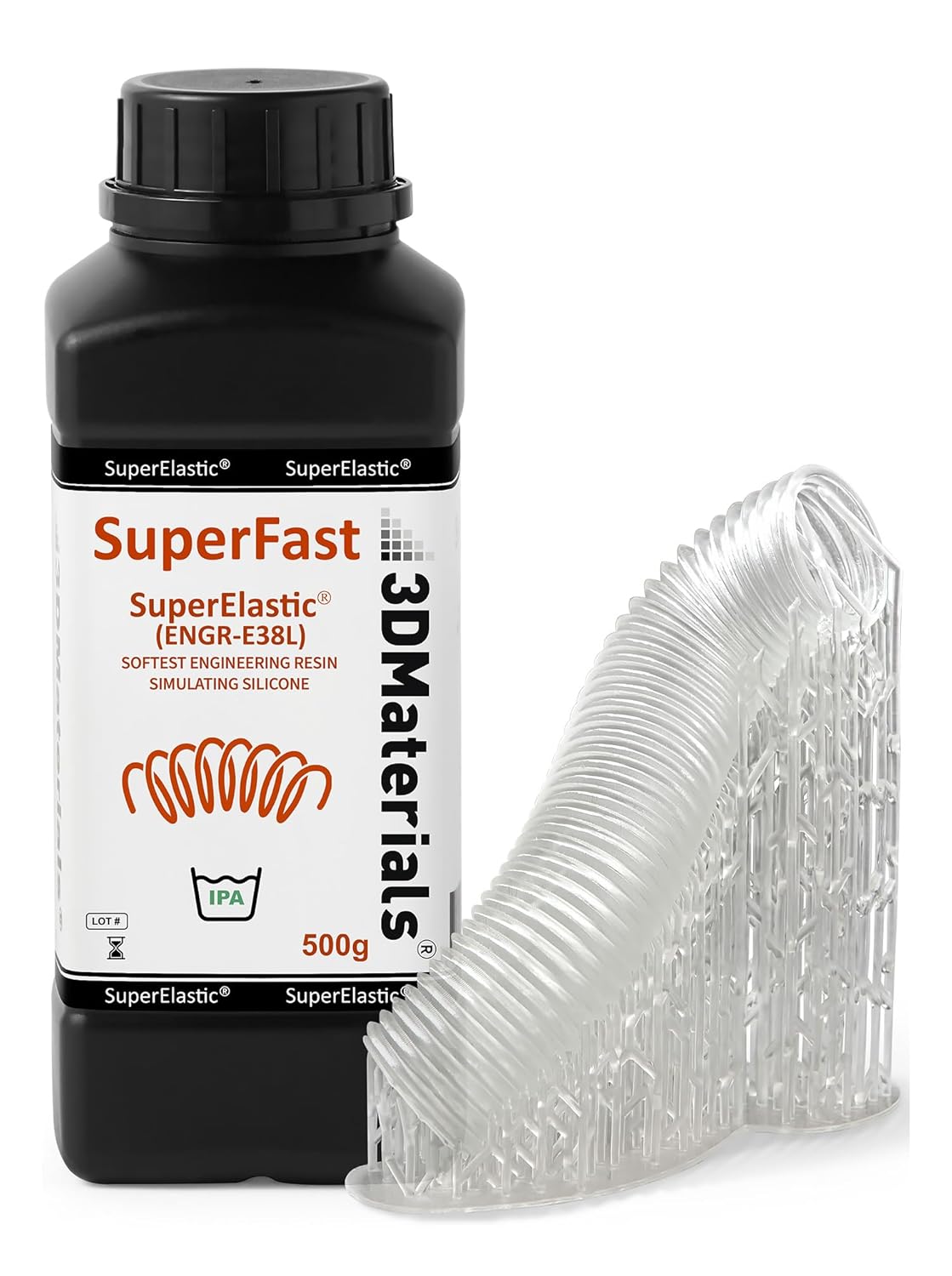
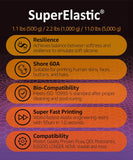
[60A Shore Hardness]Â 60A Shore durometer and 46% elongation at break well-suited for 3D printing human skins, faces, buttons, hairs
[Balanced Softness with Resilience]Â Balanced softness with resilience to simulate two component silicone prototypes
[Fast Printing]Â Printing 50um layer in 1.3 sec with monochrome LCD 3D printers, saving on time and electricity bill
[ISO 10993-5]Â Properly cleaned and fully post cured SuperElastic prints pass ISO 10993-5 test
[Balanced Softness and Strength]Â Balanced softness with strength to simulate rubber or TPU for hard flexible (80A Shore) prototypes
[80A Shore Hardness]Â 80A Shore durometer and 100% elongation at break well-suited for cushioning, damping and shock absorption
[Fast Printing]Â Printing 50um layer in 1.7 sec with monochrome LCD 3D printers, saving on time and electricity bill
[ISO 10993-5]Â Properly cleaned and fully post cured SuperFlex prints pass ISO 10993-5 test
[Non-Flammability]Â Pass UL94 V-0 non-flammability requirements and FST (AITM2-0002, AITM2-0007, AITM3-0005)
[Balanced Softness and Strength]Â Balanced softness with strength to simulate rubber or TPU for hard flexible prototypes
[80A Shore Hardness]Â Well-suited for cushioning, damping and shock absorption with non-flammability
[Compatible to All LCD Printers]Â Compatible for all kinds of LCD 3D printers
Choosing softness & post-processing, non-flammable testing, and coloring
Flexible resins have a Shore hardness range of 60A to 80A, making them well-suited for 3D printing human skin, faces, buttons, hair, cushions, dampers, and shock absorbers. Super-fast printing at 50μm layer thickness in 1.3 seconds saves both total running time and electricity costs. This fast printing boosts the productivity of a 3D printing farm by at least 40%. Properly cleaned and fully post-cured prints pass the ISO 10993-5 cytotoxicity biocompatibility test.
The halogen-free, flame-retardant oligomer synthesized by 3DMaterials enables SuperFlex V-0 to meet UL94 V-0 flammability requirements and FST standards (AITM2-0002, AITM2-0007, AITM3-0005). SuperFlex V-0 combines balanced softness and strength, simulating rubber or TPU for hard flexible prototypes, making it ideal for cushioning, damping, and shock absorption with non-flammability.
SuperElastic & SuperFlex are transparent and can be pigmented to create a variety of colors. SuperColor contains 10 times more pigment than conventional coloring agents, delivering deep black and solid white colors. Red, yellow, blue (primary colors) and orange, green, violet (secondary colors) are available, along with deep black and solid white. SuperColor is compatible with all SuperFast series, including SuperPP, SuperFlex, SuperElastic, SuperRigid, as well as other brands.
The settings chart is available at the end of this page, or you can download it by scanning QR code on the label of bottle.
Use alcohol to remove excess resin from the surface and dry the prints completely. Post-cure them using any brand’s curing machine for 20 minutes in air. One tip is the underwater (without oxygen) curing for another 10 minutes gives better result.
Add 4 drops of Black or 8 drops of White per 100 mL (gram) of resin to achieve standard deep black or solid white colors. Use a small scale and magnetic stirrer for even mixing. Adding too much SuperColor may result in printing failure.
These settings were measured and tested for a 50μm layer thickness. Adjust the exposure time by ±15% based on your printer's conditions. Colored prints were tested using the recommended number of pigment drops per 100mL of clear resin.
Thanks for subscribing!
This email has been registered!